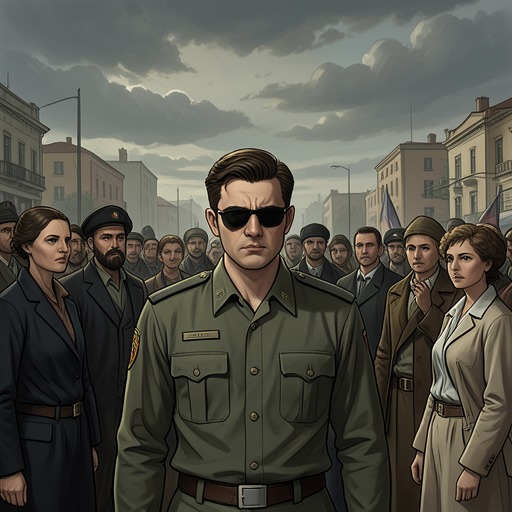
Reinhold Zucker
The Book ThiefReinhold Zucker is a twenty-four-year-old member of the LSE whose brief encounters with Hans Hubermann establish him as resentful, combative, and fatally vulnerable to the randomness of wartime service. He is introduced amid air raids, smoke, rescue work, and death, and his hostility toward Hans becomes the small human tension through which the narrative makes a larger point: in war, an apparently trivial grievance can acquire lethal consequences.
Identity and Introduction
Reinhold Zucker serves in the LSE, the unit assigned to remain aboveground during air raids, extinguish fires, support damaged buildings, and rescue people trapped in the ruins. The men also give the acronym a darker meaning, Leichensammler Einheit, or Dead Body Collectors, because collecting the dead is part of what the work entails. Zucker therefore belongs to a group already defined by exposure to destruction rather than protection from it.
He is first seen writing a letter when he interrupts Hans Hubermann’s conversation with Sergeant Boris Schipper. Zucker has a slender face, a smile resembling a sneer, and a manner that immediately sharpens the unit’s warning that danger is not located in one clear direction. His statement that the enemy is everywhere turns the LSE setting into a landscape without safety or stable boundaries. The remark is not merely military information; it anticipates the way death will arrive for him from an ordinary object and an apparently harmless circumstance.
Resentment Toward Hans Hubermann
Zucker’s antagonism becomes explicit during a card game in a town near Essen. The LSE men, resting after a long journey from Stuttgart, gamble for cigarettes, and Zucker suspects that Hans is cheating. Hans wins three hands in succession, while Zucker throws down his cards and combs his greasy hair with dirty fingernails in frustration. His anger is directed less at the game itself than at the humiliation of losing to Hans.
Hans responds to victory without boasting. He gives each colleague one of his cigarettes back and lights it for him, but Zucker refuses to receive the gesture as generosity. He snatches the cigarette and throws it into the center of the overturned box, telling Hans that he does not need charity. The refusal converts a simple exchange into a declaration of wounded pride. The sergeant asks what is wrong with Zucker, yet the others do not care enough to answer, leaving his resentment isolated and socially uncorrected.
The narrative connects the card game directly to the later accident. Zucker would not have despised Hans if he had not lost his cigarettes; without that hatred, he might not have taken Hans’s place on a road only a few weeks later. The sequence does not make Zucker’s death a moral punishment in any simple sense. Instead, it shows how a petty conflict can alter physical positions, and how a change of position can become a change between life and death.
The Accident and Death
On a surprisingly clear afternoon, the LSE men climb into their truck. Hans has just taken his appointed seat when Zucker stands above him and orders him to move. Hans asks for clarification, but the dispute is resolved by substitution: Zucker takes the place that Hans would otherwise have occupied. The event is therefore both personal and mechanical. Zucker’s hostility helps produce the exchange, but the war’s transport system, the truck, and the men’s routine determine the conditions in which the exchange becomes fatal.
The resulting accident injures several people, including Hans, who suffers a broken leg. Zucker receives the worst injury: his neck is broken, snapped almost in line with his earlobes. The stark physical description strips away the earlier comedy of the card game and replaces it with irreversible bodily damage. His death comes not during a dramatic battle or a clearly chosen act of heroism, but through the unstable movement of a military vehicle and the seat he demanded.
Narrative Function and Significance
Zucker’s story is built from a cruel reversal. He believes Hans’s victory humiliates him, rejects Hans’s cigarette as charity, and later insists that Hans surrender his seat; the action that expresses his independence places him in the position where he dies. Yet the narrative refuses to present the outcome as an orderly moral ledger. Zucker’s meanness is real, but so are the arbitrary forces surrounding him, and the broken neck remains disproportionate to the original offense.
His characterization is deliberately concentrated around a few recognizable traits: suspicion, pride, irritation, and hostility toward Hans. He is not given the extended interior development of the central figures, but his flatness serves a precise structural purpose. He embodies the ordinary soldier caught between routine and catastrophe, while the repeated contrast between cigarettes, cards, seats, and broken bodies demonstrates how wartime life allows minor objects and gestures to carry enormous consequences.
Zucker’s death also changes the meaning of Hans’s survival. Hans is injured rather than killed because Zucker occupies his place, so the earlier conflict becomes inseparable from Hans’s continued existence. The accident is thus a point at which personal resentment, institutional routine, and historical violence converge: one young man dies, another lives with injury, and the reader is left with the knowledge that the difference was determined by a seat in a truck.